Imagine being able to trade the price movements of Tesla, Apple, or Nvidia even when the U.S. stock market is closed. That is the appeal of tokenized stock perpetuals, a type of derivative that combines exposure to traditional stocks with the flexibility of crypto-based perpetual futures.
Unlike conventional stock investing, where you buy shares and become a shareholder, stock perps let you speculate on price movements by taking long or short positions without necessarily owning the underlying shares. Depending on the platform, you may also be able to trade around the clock, including weekends and holidays.
But how do tokenized stock perps actually work? How do leverage and funding fees affect your trades, and what risks should you understand before getting started? In this guide, we break down the mechanics, compare stock perps with traditional shares and other derivatives, and explore what traders should know before choosing a platform.
The Three Building Blocks of Tokenized Stock Perps
To understand tokenized stock perpetuals, it helps to break the concept into three parts: stocks, tokenization, and perpetual futures.
1. Stocks: The Underlying Reference Asset
Stocks represent ownership in a company. When you buy shares of Tesla (TSLA), Apple (AAPL), or Nvidia (NVDA), you own a stake in that company, subject to the rights attached to those shares.
With stock perpetuals, the stock serves as the reference asset whose price movements the derivative aims to track. However, trading a stock-linked perpetual does not necessarily give you ownership of the company's shares or shareholder rights.
2. Tokenization: Bringing Financial Exposure to Blockchain
Tokenization involves representing an asset, a claim on an asset, or financial exposure through a digital token on a blockchain.
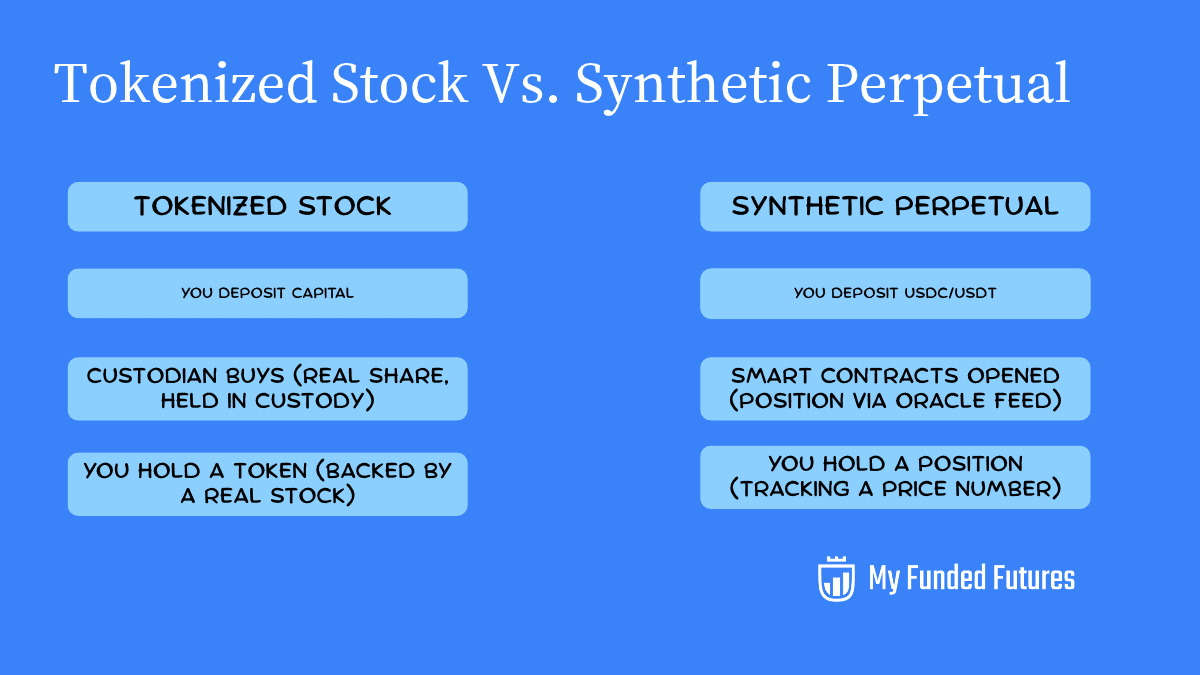
In stock-related products, a tokenized stock represents exposure to an underlying equity through a blockchain-based token. A tokenized stock perpetual, by contrast, is a derivative built around that tokenized exposure. You can therefore have a tokenized stock without a perpetual contract, and a perpetual contract whose reference asset is a tokenized stock.
Meanwhile, synthetic stock perps use derivative contracts to track a stock’s price without requiring ownership of the underlying shares. Both can provide stock-related exposure, but their structure and the rights they offer differ.
Blockchain infrastructure can facilitate digital transfers and settlement, depending on how the product is designed.
3. Perpetuals: Derivatives Without an Expiry Date
Perpetual futures, commonly called perps, are derivative contracts that do not have a fixed expiry date. Traders can take a long position if they expect the reference price to rise or a short position if they expect it to fall. Unlike traditional futures, which settle or expire on a specified date, perpetual contracts are generally kept aligned with their reference price through mechanisms such as funding payments between long and short traders. Leverage is often available, allowing traders to control a larger position with less initial margin, but it also increases the risk of liquidation.
How Does a Stock's Price Relate to a Perpetual Contract's Price?
Consider a hypothetical Nvidia-linked perpetual contract. Nvidia's share price acts as the reference, while the perpetual contract has its own market price. The two prices may move closely together, but they are not guaranteed to match exactly.
For example, if Nvidia shares trade at $180, a synthetic Nvidia perpetual might trade at $180.20. This small difference, known as a price deviation, can occur because of liquidity, supply and demand, and the contract's pricing mechanism.
How Is a Stock Perp Priced When the Market Is Closed?
A 24/7 stock perpetual does not mean the underlying stock itself is trading around the clock. When the U.S. stock market is closed, the perpetual continues to trade based on the market's expectations of where the stock's price should be.
For example, suppose Nvidia closes Friday's regular session at $180 and significant news about the company breaks on Saturday. Traders may immediately become more bullish or bearish, causing the Nvidia-linked perpetual to trade above or below $180 even though Nvidia shares are not trading on a U.S. exchange at that moment.
The perpetual is therefore reflecting new information, trader positioning, supply and demand, and the contract's pricing mechanism, rather than simply displaying the last available stock-market price.
This can create an important difference between 24/7 trading and conventional stock investing. When Nvidia's regular session opens again, its share price may move toward the level implied by the perpetual, or the two markets may continue to differ depending on liquidity and new information.
Traders should therefore avoid assuming that a stock perp's weekend price is the same as the stock's eventual Monday opening price.
How Do Tokenized Stock Perps Work in Practice?
Suppose you want to trade Nvidia's price movements but do not want to purchase its shares through a traditional brokerage account. A platform offering an Nvidia-linked perpetual may allow you to take a position based on whether you expect the stock price to rise or fall.
Here's how a typical trade works:
- 1.Choose a contract: Select the perpetual linked to the stock you want to trade.
- 2.Choose a direction: Go long if you expect the price to rise, or go short if you expect it to fall.
- 3.Allocate margin: Deposit the required collateral to open your position. 4.** Manage the trade:** Monitor price movements, leverage, funding payments, and liquidation risk.
- 4.Close your position: Realize your profit or loss based on the contract's price movement, after applicable costs.
The exact process, accepted collateral, settlement method, and trading conditions vary by platform.
How Do Funding Rates Work
The funding rate determines periodic payments exchanged between traders holding long and short positions. These payments are generally based on the difference between the perpetual contract price and the spot price, along with other factors specified by the exchange.
When perpetual futures trade above the spot price: The funding rate is generally positive, meaning traders holding long positions pay those holding short positions.
When perpetual futures trade below the spot price: The funding rate is generally negative, meaning traders holding short positions pay those holding long positions.
The funding rate and payment intervals vary by exchange and contract. Although funding payments help incentivize traders to bring perpetual futures prices closer to spot prices, they do not guarantee convergence.
Example: Trading an Nvidia Perpetual
Assume Nvidia's reference price is $180 and you open a $1,000 long position using 5× leverage. Your required initial margin would be approximately $200, excluding fees and any additional margin requirements.
If the contract's price rises by 5%, your position would gain approximately $50. If it falls by 5%, you would lose approximately $50.
These figures are illustrative and assume the contract moves in line with the reference price. Funding payments, trading fees an,d slippage are excluded. A sufficiently large adverse move could trigger liquidation, and the precise threshold depends on the platform's margin rules.
Can You Trade Tesla, Apple and Nvidia Perps 24/7?
One of the main attractions of crypto-based stock perpetuals is the possibility of trading outside regular U.S. stock-market hours.
Traditional U.S. exchanges operate during defined trading sessions, with additional premarket and after-hours sessions available through certain brokers. Some stock-linked perpetual contracts, however, are designed to trade continuously, including weekends and public holidays.
This can allow traders to respond to developments that occur while traditional stock markets are closed.
However, 24/7 availability does not mean that trading conditions remain the same throughout the week. Liquidity may be thinner outside regular market hours, spreads may widen, and a perpetual's price may temporarily diverge from the last available stock-market price. Platform maintenance or trading restrictions can also interrupt access.
Before trading, check the contract's actual trading hours and how its reference price is determined when the underlying stock market is closed.
As tokenized stock perps bring 24/7 trading to assets like Tesla, Apple, and Nvidia, traders can also explore the price-action approach of Price Action Volume Trader and discover more experienced traders in the MarketFramework Traders directory.
Tokenized Stocks vs. Synthetic Stock Perps vs. Traditional Shares
Although these products can all provide exposure to a company's stock, they are not interchangeable.
| Feature | Traditional Shares | Tokenized Stocks | Synthetic Stock Perps |
|---|---|---|---|
| What you hold | Shares in a company | A token representing shares, or a claim, or specified exposure | A derivative contract |
| Ownership rights | Shareholders’ rights apply, generally | Depend on the token’s legal structure | No ownership of underlying shares, generally |
| Expiry | No fixed expiry | Depends on the product | Typically no fixed expiry |
| Leverage | Usually 1x when buying with cash; margin may allow more | Usually 1x when bought outright; higher if margin is offered | 2x, 5x, 10x or higher are offered depending on the platform |
| Trading hours | Regular session: 9:30 a.m. ET to 4 p.m. ET, Monday through Friday, with premarket trading starting at 8 a.m. and after-hours at 4 p.m. through 8 p.m.
Overnight trading is facilitated through Blue Ocean ATS, which runs from 8 p.m. ET to 4 a.m. ET, from Sunday through Thursday
| Transfers 24/7; Trading depends on the venue | 24/7 |
| Costs | Brokerage fees and other applicable charges, overnight spread and no holding cost | Product-specific exchange fees, spread, premium and gas (network transaction costs for execute trade on a public blockchain); no holding costs except for dividend fees | Trading fees and potentially funding payment, slippage and liquidation |
Where Can You Trade Tokenized Equity Perps and Synthetic Stock Perps?
These products are available on selected crypto exchanges and decentralised trading platforms.
- 1.Kraken: Offers perpetual contracts linked to xStocks, tokenized equities such as Tesla, Apple and Nvidia, subject to regional eligibility.
- 2.Ondo Perps: Offers perpetual exposure to US stocks and ETFs, with product availability and collateral options depending on eligibility.
- 3.Hyperliquid / Trade.xyz: Offers synthetic equity perpetuals designed to track stock prices without requiring ownership of the underlying shares.
What Are the Benefits of Tokenized Stock Perps?
1. Flexible trading hours
Where contracts operate continuously, traders can take positions outside regular US market hours instead of waiting for the next exchange session.
2. Long and short opportunities
Traders can potentially profit from rising or falling prices, depending on the direction of their positions and how the contract performs.
3. Capital efficiency through leverage
Leverage allows traders to open positions larger than their initial margin. This can reduce the upfront capital required, but it also magnifies losses and increases liquidation risk.
4. Crypto-based trading infrastructure
Some platforms integrate stock-linked derivatives into crypto trading interfaces, potentially allowing eligible users to use supported digital assets as collateral.
These advantages depend on the specific product, platform and jurisdiction. They should not be interpreted as guarantees of lower costs, better execution or uninterrupted market access.
What Risks Should Traders Understand?
Tokenized stock perpetuals introduce several risks that differ from simply holding shares.
- Leverage and liquidation: A relatively small adverse price movement can cause substantial losses on a leveraged position. -** Funding payments:** Depending on the funding rate and position direction, traders may need to make periodic payments, which can erode returns.
- Liquidity and slippage: Thin markets can make it more expensive to enter or exit a position at the expected price.
- Price-tracking differences: The perpetual may trade above or below the underlying stock's reference price. -** Platform and counterparty risk:** Traders depend on the platform's operational reliability, custody arrangements and ability to honor its contractual obligations. -** Blockchain and smart-contract risk:** Where blockchain infrastructure or smart contracts are involved, technical vulnerabilities and network disruptions may introduce additional risks.
- Regulatory and geographic restrictions: Access, investor protections, tax treatment and permitted products vary across jurisdictions.
A perpetual's lack of an expiry date does not mean a position can be held indefinitely without cost or risk.
What Happens to Dividends and Corporate Actions?
Dividends, stock splits, mergers and other corporate actions are handled according to the terms of the specific token or perpetual contract.
A trader holding a synthetic stock perpetual generally does not receive the underlying company's dividend as a shareholder would. However, a platform may use an adjustment, payment or other mechanism to account for corporate actions or changes in the reference asset.
Stock splits, mergers, ticker changes and other corporate events can also affect the reference price or contract specifications. The exact treatment varies by platform and product.
Before trading a stock-linked perpetual, check the platform's documentation to understand how dividends and corporate actions are handled. Do not assume that holding a stock perp gives you the same rights or benefits as owning the underlying shares.
How to Evaluate a Stock Perps Platform
Before choosing a platform, examine the actual contract specifications rather than relying solely on advertised leverage or 24/7 access.
Check the following:
- Product structure: Is the product a token representing shares, a derivative, or another form of exposure?
- Trading availability: Are Tesla, Apple and Nvidia contracts available continuously, including weekends?
- Fees and funding: What are the trading fees, funding methodology and payment intervals?
- Leverage and liquidation: What margin is required, and how are liquidation prices calculated?
- Liquidity and execution: How deep is the market, and how wide are the spreads during quieter sessions?
- Collateral and withdrawals: Which assets are accepted, how are they held, and what withdrawal restrictions apply? -Regulatory eligibility: Check whether the product is available to U.S. residents and what investor protections, restrictions, and tax rules may apply. Check the platform's current eligibility requirements before depositing funds or opening a position.
Compare the full cost and structure of the product, not just the headline trading fee.
Conclusion
Tokenized stock perpetuals combine stock-price exposure with the flexibility of perpetual derivatives. Depending on the platform, they can provide opportunities to trade long or short beyond regular US stock-market hours, sometimes around the clock.
However, tokenized stocks and synthetic stock perps are not the same thing. The former may represent shares or claims linked to them, while the latter provide derivative exposure to price movements without necessarily conveying ownership. For traders considering these products, understanding the contract structure, funding costs, leverage, liquidity and platform risks is just as important as predicting whether Tesla, Apple or Nvidia will rise or fall.
¹This material is provided for educational purposes only and should not be relied upon as trading, investment, tax, or legal advice. All participation in MyFundedFutures (MFFU) programs is conducted in a simulated environment only; no actual futures trading takes place. Performance in simulated accounts is not indicative of future results, and there is no guarantee of profits or success. Fewer than 1% of participants progress to a live-capital stage with an affiliated proprietary trading firm. Participation is at all times subject to the Simulated Trader Agreement and program rules.
Frequently Asked Questions
Related Posts
Read our most popular posts
Which Trading Platform Should You Use with a Funded Futures Account
Compare trading platforms for MyFundedFutures accounts, including Tradovate, NinjaTrader, Quantower, Volumetrica, ATAS and Hyperprop, to find the right fit.

Prop Firms With Static Drawdown in 2026: The Best Fixed-Risk Plans
Compare the best futures prop firms with static drawdown in 2026, including drawdown rules, account sizes, profit splits and payouts before you choose.

Fastest Prop Firm Payouts in 2026: Which Firms Pay Same Day?
Compare the fastest futures prop firm payouts in 2026, including eligibility rules, processing times, withdrawal limits, buffers and payout flexibility.
