
Static drawdown has become an increasingly important feature for futures traders comparing proprietary (prop) trading firms in 2026. Unlike trailing drawdown, which raises the account’s loss threshold as profits accumulate, a static drawdown keeps the maximum-loss floor fixed. This can make risk easier to manage and allows traders to build profits without continuously moving the level at which the account can be breached.
MyFundedFutures’ Studio plans have renewed interest in this model. Studio combines a static maximum-loss limit with no Daily Loss Limit, no consistency rule and flexible payout access, creating a different risk and payout structure from MFFU’s trailing-drawdown plans.
But static drawdown does not automatically make a prop plan better. Account size, maximum loss, profit target, trading rules, payout requirements, consistency restrictions and the transition from evaluation to funded trading can vary significantly among firms.
This guide ranks the leading prop-firm plans with static drawdown in 2026 and compares the features that matter most when evaluating fixed-risk trading accounts.
Static Drawdown Explained With Example
Static drawdown means the maximum-loss threshold on a prop trading account remains fixed at its original level, regardless of how much profit the trader makes.
For example, consider a $10,000 account with a $1,000 static drawdown. The $10,000 account does not necessarily give a trader $10,000 of usable risk. In this example, the actual loss allowance is $1,000, while the remaining $9,000 represents the fixed account floor.
If the trader generates $500 in profit, the account balance rises to $10,500, but the loss floor remains at $9,000. If the trader earns another $1,500, bringing the balance to $12,000, the floor still stays at $9,000. As profits accumulate, the trader gains a larger cushion above the fixed loss threshold.
| Account Balance | Static Drawdown Floor | Remaining Cushion |
|---|---|---|
$10,000 | $9,000 | $1,000 |
$10,500 | $9,000 | $1,500 |
$11,000 | $9,000 | $2,000 |
$12,000 | $9,000 | $3,000 |
If the trader generates $500 in profit, the account balance rises to $10,500, but the loss floor remains at $9,000. If the trader earns another $1,500, bringing the balance to $12,000, the floor still stays at $9,000. As profits accumulate, the trader gains a larger cushion above the fixed loss threshold.
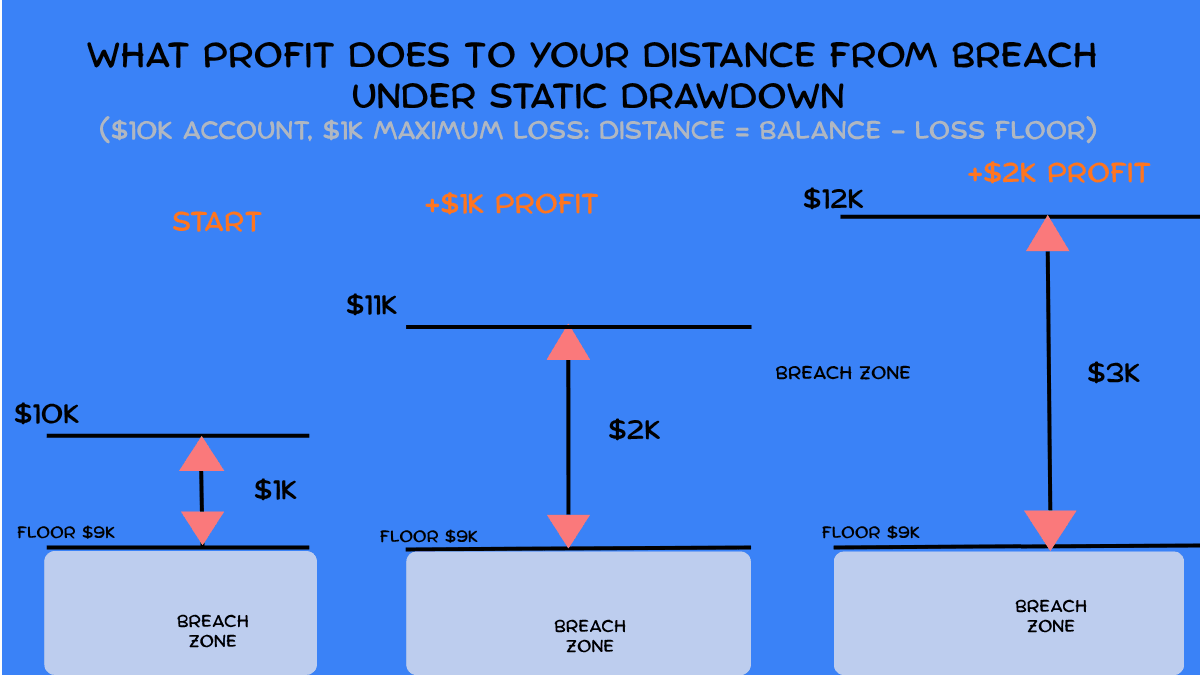
While trailing drawdown adjusts the maximum loss threshold upward as the account reaches new highs, potentially tracking gains in real time, including unrealized profits, EOD trailing drawdown adjusts the loss threshold based on the account’s performance at the end of the trading day, rather than continuously during the session.
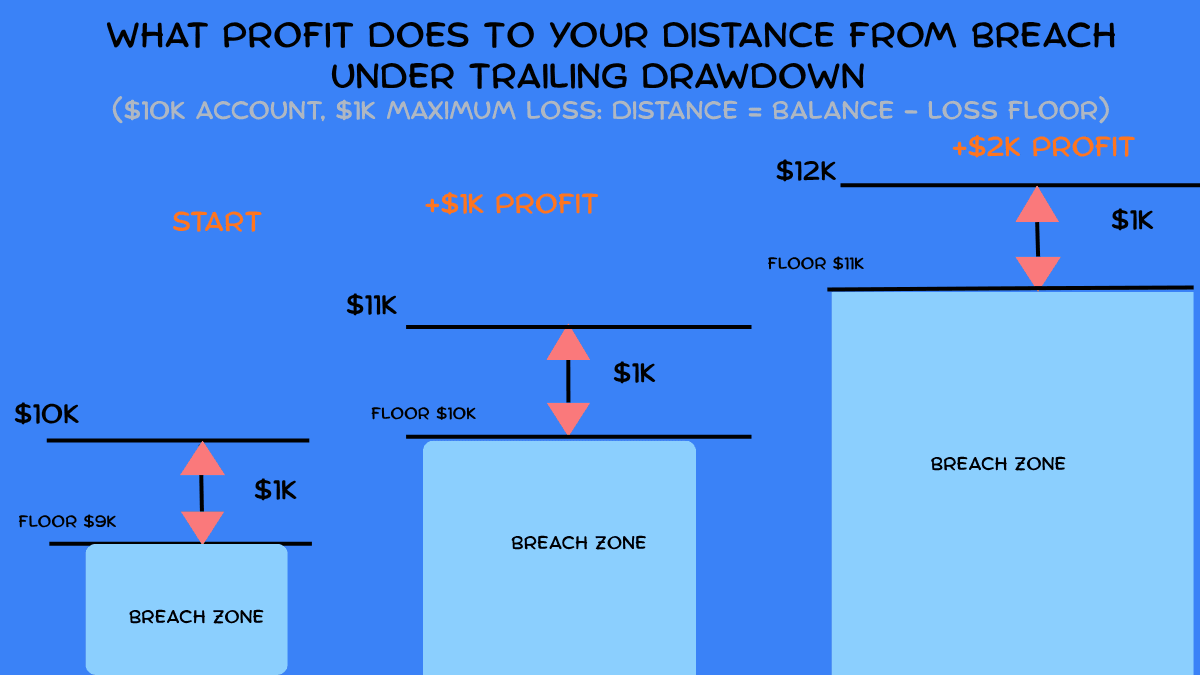
Static vs. Trailing Drawdown: What’s the Difference?
| Feature | Static Drawdown | Trailing Drawdown | EOD Trailing Drawdown |
|---|---|---|---|
Loss floor | Fixed | Moves higher | Adjusts based on EOD balance |
Effects of Profits on Drawdown | None | Can raise threshold | Can raise threshold |
Risk calculation | Simpler | Dynamic | Complex |
Risk of losing accumulated profits | Lower | Higher | Moderate |
Best Suited for | Fixed-risk traders | Traders comfortable with trailing risk | Traders wanting drawdown limits to be adjusted only at the end of the day |
Static Drawdown Prop Firms: How Do They Compare?
To rank the best static-drawdown prop firms in 2026, we evaluated more than the advertised account size and maximum-loss limit. The comparison considers whether the drawdown remains fixed during the Evaluation and Sim Funded stages, along with profit targets, Daily Loss Limits (DLLs), consistency rules, contract limits, payout eligibility, withdrawal caps, profit splits and upfront fees.
We also considered how each plan balances risk flexibility with access to profits, since a static loss threshold does not necessarily mean fewer trading restrictions or more favorable payout terms.
The following rankings assess how these features compare across available plans.
#1 MyFundedFutures Studio: New Static-Drawdown Plans With Flexible Sim Funded Payouts
MyFundedFutures’ Studio Plans (Studio #001, Studio #002, Studio #003) stand out for offering a static maximum-loss limit (MLL) that keeps the drawdown floor fixed as the account grows. Available in $10,000 and $20,000 account sizes, Studio #001 has a $500 static MLL, while Studio #002 has a $1,000 limit. Unlike trailing-drawdown models, the loss threshold does not rise as profits accumulate, giving traders a more predictable risk boundary. The static MLL applies during both Evaluation and Sim Funded stages, alongside no Daily Loss Limit (DLL) and no consistency rule.
Studio #001 | Studio #002 | Studio #003 | |
| Account Size | $10K | $20K | $5K |
|---|---|---|---|
| One-time fee | $140 | $280 | $75 |
| Maximum loss limit (Static) | $500 | $1K | $250 |
Profit target (Evaluation) | $1K | $2K | $500 |
Daily profit cap (Sim-funded) $5K $10K $2.5K | |||
| Contract limits | 10 micros (no minis) | 20 micros (no minis) | 5 micros (no minis) |
| DLL | None | None | None |
| Consistency | None | None | None |
| Minimum trading days | None | None | None |
For MyFundedFutures Studio #001, #002 and #003, the Live starting balance is 40% of the total payout amount requested, capped at $2,000. The Live account uses an end-of-day (EOD) trailing Max Loss Limit (MLL) that starts at the Live starting balance and trails upward until it locks at $100. Traders receive a 90/10 profit split, with a $250 minimum payout and one payout request permitted per day. Contract limits vary by plan: Studio #001 allows up to 10 micros, Studio #002 up to 20 micros, and Studio #003 up to 1 mini or 10 micros.
Other Prop Firms With Static Drawdown
#2 Phidias Express to Live
Phidias Prop Firm’s Express to Live plans offer a one-time payment, static drawdown and a direct path from a cash account (Sim-funded account) to live funding after the first payout. Available in $25K, $50K, $100K and $150K sizes, the plans feature no consistency rule, no Daily Loss Limit (DLL) and news trading allowed. Traders who meet the account-specific profit target can qualify for an 80/20 bonus payout and receive live trading credit, with daily unlimited payouts advertised for the Live Funded stage.
Key Features
- Account sizes: $25K, $50K, $100K and $150K
- One-time fees: $69.25, $108.45, $180 and $225, respectively, with the advertised discounts
- Drawdown: Static; never trails
- Profit targets: $1,500 / $2,500 / $3,500 / $4,500
- Maximum positions: 2 / 5 / 7 / 9 minis, or 20 / 50 / 70 / 90 micros
- Consistency rule: None
- Daily Loss Limit: None advertised
- News trading: Allowed
- Activation fee: Advertised as $0 with the one-time payment
- Path to Live: Meet the profit target to qualify for the advertised bonus payout and live trading credit
- Bonus payout (80/20): $1,000 / $2,000 / $3,000 / $4,500
- Live trading credit: $500 / $1,000 / $1,500 / $2,000
- Live payouts: Daily unlimited payouts advertised after upgrading to a Live Funded Account
#3 Elite Trader Funding Static
Elite Trader Funding offers Static Evaluation plans in $10K, $25K and $50K account sizes, each with a fixed maximum-loss threshold that never trails as profits accumulate. With no Daily Loss Limit (DLL), traders can focus on meeting the profit target without a separate daily loss cap. However, passing the evaluation requires at least five trading days, and payout eligibility is subject to additional trading-day requirements and withdrawal caps.
Key Features:
- Account sizes: $10K, $25K and $50K
- Evaluation fees: $147, $277 and $497, respectively; auto-renew every 30 days
- Static maximum drawdown: $500, $1,000 and $2,000, respectively
- Profit targets: $1,000, $2,000 and $4,000, respectively
- Daily Loss Limit: None
- Maximum position size: 1, 2 or 4 minis, respectively (10, 20 or 40 micros)
- Minimum trading days to pass: 5
- Minimum average trading days before first payout: 8
- Maximum withdrawal per payout: $1,000, $1,500 and $2,000, respectively
- Reset fee: $47
- Activation fee: $87 monthly or $177 one-time, as listed by the firm
#4 BluSky Trading Static Plans
The firm’s static drawdown lineup includes Propel 150K, 200K, and 300K, Launch 200K and Orbit 200K. Propel and Launch use a buffer stage before payouts. Orbit skips the buffer, charges a one-time fee, and is static only in evaluation. All five pay a 90% split in the brokerage stage, with no profit payout caps.
Key Features
- Plans: Propel 150K, 200K, and 300K, Launch 200K and Orbit 200K
- Listed Price: Applicable subscription pricing and recurring fee varies by plan, except for Orbit 200K for which a one-time $419 price is charged.
- Profit Target: $3,000, $6,000, $20,000, $6,000 and $8,000, respectively
- Static drawdown (Evaluation): $1,000, $2,000, $5,000, $2,000 and $3,000, respectively
- Static drawdown (buffer stage): $1,000, $2,000, $2,500 and $2,000 for the first four; This doesn’t apply to Orbit, whose funded stage uses a $3,000 EOD trailing drawdown
- Buffer requirement: $2,000, $3,000, $3,500 and $3,000 for the first four and none for Orbit
- Consistency rule: 34%, 34%, 21%, 50% and none in the evaluation; 34%, 34%, 21% and 34% in the buffer stage for the first four; 40% in the Orbit funded stage
- Funded starting balance: $2,000, $3,000, $3,500 and $3,000 for the first four
- Minimum payout: $500 on all five
- Payout caps: none in the brokerage stage on any plan; Orbit has a $2,500 weekly cap in the funded stage
- Profit split: 90/10 to the trader in the brokerage stage, with a Bonus Vault
#5 PropEd Capital: TrueRisk Instant Funded
PropEd Capital’s TrueRisk Instant Funded plans provide access to funded trading without a traditional evaluation profit target. The plans offer static drawdown equal to the account size, meaning the maximum-loss threshold does not trail upward as profits accumulate. Account options range from $2,500 to $10,000, with a 120% buffer requirement, 20% consistency rule and payout caps that vary by account size.
Key Features:
- Account sizes: $2,500, $5,000, $7,500 and $10,000
- Listed Prices: $399.50, $599.50, $799.50 and $999.50, respectively
- Profit target: $0; instant-funded access
- Static drawdown: Equal to the account size
- Buffer requirement: 120%
- Consistency rule: 20% for both evaluation and funded stages, as listed
- Minimum payout: $500
- Payout caps: $3,000, $4,000, $5,000 and $5,000, respectively
Why These Prop Firms Rank Where They Do
- #1 MyFundedFutures Studio: Ranks first for combining static drawdown during Evaluation and Sim Funded trading with no DLL, no consistency rule and flexible payout requests. Its main drawback is the switch to EOD trailing drawdown in the Live stage.
- #2 Phidias Express to Live: Offers static drawdown, no DLL or consistency rule, and a defined path to Live funding. Its transition to Live-stage rules is an important consideration when assessing long-term risk flexibility.
- #3 Elite Trader Funding Static: Provides straightforward static-drawdown evaluations with no DLL and clearly defined loss limits. Minimum trading-day requirements, payout conditions and withdrawal caps reduce its flexibility.
- #4 BluSky Trading Static Plans: Offers several static-drawdown plans with different account sizes and funding structures. Buffer requirements, consistency rules and Orbit’s switch to EOD trailing drawdown make the plans more complex.
- #5 PropEd Capital TrueRisk Instant Funded: Stands out for providing instant-funded access without a traditional evaluation profit target. However, higher upfront costs, a 120% buffer requirement and a 20% consistency rule may limit its appeal to payout-focused traders.
What to Check Before Choosing a Static-Drawdown Prop Firm
- Does the static drawdown remain fixed after passing the evaluation?
- Is there a Daily Loss Limit?
- Is there a consistency rule?
- Is a buffer required before payouts?
- How many trading days are required?
- When is the first payout available?
- Are payouts capped?
- Does the account switch to trailing or EOD trailing after funding?
- What happens when the trader moves to a Live account?
- What are the reset, activation or recurring fees?
Conclusion
MyFundedFutures Studio leads this comparison for its combination of static drawdown and flexible Sim Funded trading rules. However, traders should weigh its Live-stage drawdown transition against the advantages offered by alternatives such as Phidias and Elite Trader Funding. Before choosing a plan, compare the rules that govern funded trading and payouts, not just the advertised account size or maximum-loss limit.
¹This material is provided for educational purposes only and should not be relied upon as trading, investment, tax, or legal advice. All participation in MyFundedFutures (MFFU) programs is conducted in a simulated environment only; no actual futures trading takes place. Performance in simulated accounts is not indicative of future results, and there is no guarantee of profits or success. Fewer than 1% of participants progress to a live-capital stage with an affiliated proprietary trading firm. Participation is at all times subject to the Simulated Trader Agreement and program rules.
Frequently Asked Questions
Related Posts
Read our most popular posts

Announcing: MyFundedPerps
MyFunded announces MyFundedPerps, a new prop-trading platform expanding into perpetual futures and digital assets. Built on the foundation of MyFundedFutures with enhanced technology, it offers traders access to multiple markets and asset classes.

Benefits of Short Selling in Futures Versus Stocks
Short selling stocks comes with borrow fees, locate requirements, the uptick rule, and the pattern day trader rule. Futures have none of those barriers; a short entry works exactly like a long entry, because the market was built that way. This guide covers the mechanics on both sides, where futures shorts hold a real edge, and what to know before shorting inside a funded account.
What Is Hedging in Futures Trading? Do Prop Firms Allow It?
Hedging offsets risk on one position by holding another that gains when the first loses. It’s one of the oldest tools in futures; and one of the most misunderstood rules in prop trading. Policies differ sharply between firms, and getting it wrong can end an account. This guide explains how hedging works, the forms it takes, and exactly where firms like MyFundedFutures draw the line.