
Fast payouts matter because they give futures prop firm traders quicker access to their eligible profits, improving cash flow and helping them reinvest earnings, cover trading expenses, or build personal capital without unnecessary delays. However, traders should look beyond advertised payout frequency and compare eligibility requirements, approval times, actual processing speeds, and withdrawal limits to determine how quickly they can access their money.
Before You Buy: What Determines How Fast You Get Paid
A futures prop firm's advertised payout timeline doesn't always reflect how quickly money reaches your bank account. Several factors determine the time between earning profits and receiving your withdrawal.
1. Daily Payout Eligibility vs. Actual Payment Speed
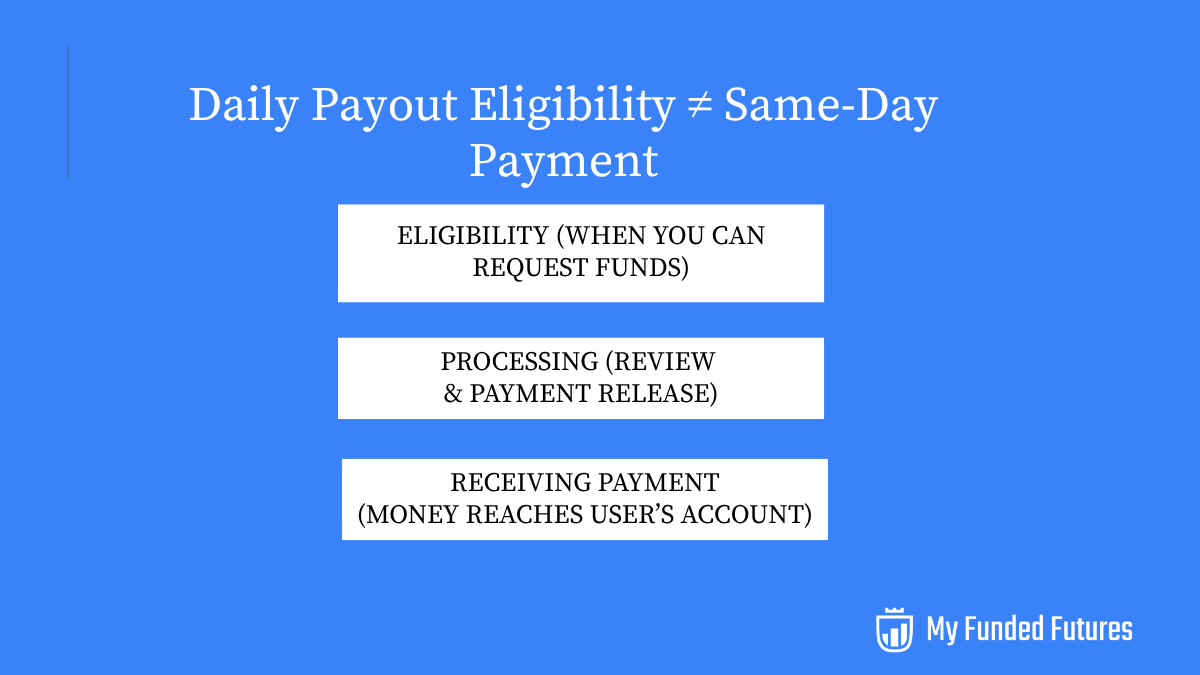
Daily payout eligibility means you can request a withdrawal each day, provided you meet the firm's requirements. It doesn't guarantee that the request will be approved or that the money will arrive that day. Compare three separate stages:
- payout eligibility (when you can request funds)
- approval and processing (when the firm reviews and releases the payment), and
- fund receipt (when the money reaches your account).
A firm offering daily requests may still take several business days to deliver the funds.
2. Minimum Profit Requirements and Safety Buffers
Some firms require traders to accumulate a minimum profit balance or maintain a safety buffer before withdrawing. These requirements can reduce the amount available for withdrawal or delay the first payout, even after a trader becomes eligible. Check the minimum withdrawal amount, required profit buffer, and any restrictions on how much you can take out.
3. Consistency Rules and Trading-Day Requirements
Consistency rules may limit how much of your total profit can come from a single trading day. Other firms require a minimum number of qualifying trading days or impose waiting periods between withdrawals. These conditions can delay payouts even when the account is profitable. Check whether consistency requirements apply during evaluation, in simulated-funded accounts, or in live accounts.
4. Approval Times and Verification Checks
Submitting a withdrawal request is not the same as receiving approval. Firms may review trading activity, verify identity, request tax documentation, or conduct compliance checks before releasing funds. First-time withdrawals may require additional verification. Review the firm's stated approval and processing timelines, including whether they are measured in business days or calendar days.
5. Payment Methods and Bank Processing
The payment method affects how quickly funds arrive after a firm releases them. Bank transfers, payment processors, and other supported methods can have different settlement times, fees, and availability. International traders may also encounter currency-conversion costs or intermediary-bank delays. Weekends and public holidays can extend the wait, even when the firm processes the request promptly.
6. Payout Reliability and Track Record
Speed matters only if the firm pays reliably. Examine the published payout policy, eligibility conditions, and recent trader feedback for recurring complaints about unexplained delays, rejected requests, or changing requirements. User reports are useful context, but they are not proof of future payment performance. Prioritize firms with clear written rules and transparent explanations of processing timelines.
When comparing futures prop firms, don't judge speed by the phrase daily payouts alone. Establish how quickly you become eligible, how long approval takes, and how many additional days the transfer may require. These three stages provide a more realistic picture of when you can actually access your profits.
How We Evaluate Prop Firm Payout Speed
Our methodology compares futures prop firms across four criteria:
First-Payout Eligibility: How soon traders can qualify to request their first withdrawal. **Payout frequency: **Whether requests are available daily, on demand or at fixed intervals. Processing and settlement time: How long approval takes and when funds typically reach the trader. Withdrawal restrictions: Minimum withdrawals, payout caps, buffers, consistency rules and other conditions that can delay access to profits.
We prioritize official firm policies and distinguish payout eligibility from approval, processing and final settlement. Where available, we also consider credible third-party reports and trader feedback, while noting that reported experiences do not guarantee future payment times.
#1 MyFundedFutures — Studio #001 , #002 & #003
MyFundedFutures takes the top spot with its new Studio #001, Studio #002 and Studio #003 plans, because they go beyond the traditional daily-payout model: traders can request eligible Sim Funded profits anytime.
That is the key innovation. A daily payout plan gives traders a recurring opportunity to withdraw, but “daily” still implies a payout window or eligibility cycle. Studio removes that waiting structure. Once a trader reaches Sim Funded status, closes all positions and has at least $250 available to request, payouts can be requested anytime, with no waiting period, no payout buffer and no qualifying trading days.
In other words, Studio changes the question from “When is my next payout day?” to “When am I ready to withdraw?” That is a meaningful distinction for traders who prioritize immediate access to eligible profits.
The plans also simplify the path to a payout by combining anytime withdrawals with a static Max Loss Limit, no Daily Loss Limit, no consistency rule and no minimum trading-day requirement. Studio #001 costs $140 for a $10,000 account, Studio #002 costs $280 for a $20,000 account and Studio #003 costs as little as $75 for a $5,000 account. The Studio #001 and Studio #002 offer a $250 minimum payout, while the Studio #03 offers a $100 minimum payout, with all the three offering an 80% Sim Funded profit split.
MFFU's standard payout structures can already offer fast processing, but Studio represents a different model: on-demand payout eligibility rather than simply faster processing within a daily or periodic payout schedule. MFFU says most payouts are approved instantly, although manual reviews can take 6–12 business hours.
Studio's breakthrough is not merely that MFFU pays quickly. It is that the trader can request eligible profits on demand. That makes Studio the strongest choice in this comparison for traders whose primary priority is minimizing the time between becoming payout-eligible and being able to request their money.
| Rank | Prop Firm | Payout Model |
|---|---|---|
| #1 | MyFundedFutures | Anytime/On-demand |
| #2 | Take Profit Trader | Day-One + Daily |
| #3 | Tradeify Select Daily | Daily |
| #4 | Lucid Trading Daily | Daily |
| #5 | Goat Funded Futures | Every 24 hours |
| #6 | FundedNext Futures Rapid Daily | Daily |
Top Prop Firms: Pros and Cons at a Glance
MyFundedFutures — Studio #001/#002
- Pros: Anytime payouts; no minimum trading days; no consistency rule.
- Cons: $250 minimum; account sizes limited to $10K/$20K; Studio is offered exclusively through Hyperprop.
Take Profit Trader — Pro/Pro+
- Pros: Day-one and daily payouts; fast wallet transfers.
- Cons: $250 minimum; $50 fee below $250.
Tradeify — Select Daily
- Pros: Daily eligibility; 24–48h to Rise wallet; 90/10 split.
- Cons: Three evaluation trading days; payout caps and buffers.
Lucid Trading — Daily
- Pros: Daily requests; no minimum trading days; no consistency rule.
- Cons: $500 minimum; buffer must be maintained.
Goat Funded Futures
- Pros: Payouts every 24 hours; no consistency rule; 90/10 split.
- Cons: $500 minimum; 3% processing fee; buffer required.
FundedNext Futures — Rapid Daily
- Pros: Daily payouts; no consistency rule; 90/10 split.
- Cons: $1,500 profit target before payout; 800–2,500 withdrawal caps.
MyFundedFutures’ New Studio Plans Explored
Studio #001 (S1)
- S1 is the smaller entry-level offering, priced at a one-time $140 for a $10,000 account, with no activation fee.
- It has a $1,000 evaluation profit target, a static $500 maximum loss limit, no daily loss limit, no consistency rule and no minimum trading days.
- Once Sim Funded, traders can request payouts anytime, provided positions are closed, with a $250 minimum and an 80/20 profit split.
- There is no payout buffer or waiting period, but daily simulated profits above $5,000 are forfeited.
- It suits traders who want predictable drawdown limits and frequent access to profits without navigating multiple payout conditions.
- It is less suitable for traders who need larger contract exposure, as it permits up to 10 micro contracts and no minis, or those who prefer a larger account.
Studio #002 (S2)
- S2 offers the same rule structure at a larger scale, with a one-time $280 fee for a $20,000 account.
- Its evaluation target is $2,000 and its static maximum loss limit is $1,000.
- It allows up to 20 micro contracts, no minis, and caps daily Sim Funded profits at $10,000.
- Payouts follow the same anytime-request model, with a $250 minimum and an 80/20 split in Sim Funded, increasing to 90/10 upon transition to Live.
- Traders become eligible for Live after five approved payouts or $10,000 in total requested payouts, subject to the firm's terms.
- This plan suits traders who want the same simplified rules as Studio #001 with greater trading capacity.
- It may not suit traders seeking unrestricted profit withdrawals, larger account sizes or multiple active Studio accounts.
<a class="btn cta-btn" target="_blank" rel="noopener noreferrer" href="https://myfundedfutures.com/challenge?id=139"> Explore Fast Payouts with MyFundedFutures and access eligible profits on demand with Studio</a>
Studio #003 (S3)
- S3 offers the same rule structure at a smaller scale, with a one-time $75 fee for a $5,000 account.
- Its evaluation target is $500 and its static maximum loss limit is $250.
- It allows up to 20 micro contracts, no minis, and caps daily Sim Funded profits at $2,500.
- Payouts follow the same anytime-request model, with a $100 minimum and an 80/20 split in Sim Funded. Upon transition to Live, the profit split increases to 90/10, with a $250 minimum payout and one request permitted per day.
- Traders become eligible for Live after five approved payouts or $5,000 in total requested payouts, subject to the firm's terms.
- This plan suits traders who want Studio’s simplified rules, a lower $100 minimum Sim Funded payout and greater flexibility when accessing eligible profits.
- It may not suit traders seeking larger account sizes, unrestricted withdrawals or multiple active Studio accounts.
Studio vs. Rapid and Rapid EOD: Drawdown and Payout Flexibility
The key distinction is drawdown structure and payout flexibility: Studio’s static plan uses a fixed maximum-loss limit, so the drawdown does not trail the trader’s highest balance, and it combines that structure with no Daily Loss Limit, no consistency rule and anytime payouts once Sim Funded.
By contrast, Rapid uses an EOD trailing Max Loss and no DLL, while Rapid EOD also uses an EOD drawdown structure but is designed around a more payout-focused model, with its own payout and consistency requirements.
In practical terms, Studio is the simpler choice for traders who want predictable risk boundaries and maximum payout flexibility, whereas Rapid and Rapid EOD may suit traders who are comfortable with trailing drawdown mechanics in exchange for their respective payout structures.
Availability note: Studio is a limited-availability offering sold through MFFU's dedicated Studio page and currently runs exclusively on Hyperprop. Its availability and daily purchase caps may limit access, so traders should check the official page before purchasing.
Conclusion
The fastest futures prop firm payout depends on more than how frequently traders can request withdrawals. MyFundedFutures Studio stands out for its anytime payout requests once Sim Funded, while Take Profit Trader, Tradeify, Lucid Trading, Goat Funded Futures and FundedNext Futures offer alternative payout schedules with their own eligibility rules and restrictions. Before choosing a firm, compare minimum payout amounts, profit buffers, withdrawal caps, consistency requirements and processing times. Ultimately, the best option is the one that combines quick access to eligible profits with transparent rules, reliable processing and a risk structure that suits your trading strategy.
¹This material is provided for educational purposes only and should not be relied upon as trading, investment, tax, or legal advice. All participation in MyFundedFutures (MFFU) programs is conducted in a simulated environment only; no actual futures trading takes place. Performance in simulated accounts is not indicative of future results, and there is no guarantee of profits or success. Fewer than 1% of participants progress to a live-capital stage with an affiliated proprietary trading firm. Participation is at all times subject to the Simulated Trader Agreement and program rules.
Frequently Asked Questions
Related Posts
Read our most popular posts

Announcing: MyFundedPerps
MyFunded announces MyFundedPerps, a new prop-trading platform expanding into perpetual futures and digital assets. Built on the foundation of MyFundedFutures with enhanced technology, it offers traders access to multiple markets and asset classes.

Benefits of Short Selling in Futures Versus Stocks
Short selling stocks comes with borrow fees, locate requirements, the uptick rule, and the pattern day trader rule. Futures have none of those barriers; a short entry works exactly like a long entry, because the market was built that way. This guide covers the mechanics on both sides, where futures shorts hold a real edge, and what to know before shorting inside a funded account.

What Is Hedging in Futures Trading? Do Prop Firms Allow It?
Hedging offsets risk on one position by holding another that gains when the first loses. It’s one of the oldest tools in futures; and one of the most misunderstood rules in prop trading. Policies differ sharply between firms, and getting it wrong can end an account. This guide explains how hedging works, the forms it takes, and exactly where firms like MyFundedFutures draw the line.