
Most traders dive headfirst into funded accounts without fully considering whether the prop firm account size matches their risk tolerance.
Prop firms provide funded trading accounts in various account sizes, where you trade their capital.
In exchange, the profits are shared, often with favorable splits typically ranging from 80-90% in favor of consistent traders.
Most firms require passing an evaluation phase before offering live accounts.
The account size you select will influence evaluation costs, applicable trading rules, your profit potential, and even the psychological pressure you'll face during the challenge.
Unlike forex or stock prop trading, futures prop firm accounts come with unique structures -- trailing drawdowns, exchange data fees, and contract limits -- that make the choice of account size especially significant.
Bigger isn't always better.
Why Account Size Matters in Futures Prop Trading
Evaluation Cost
Larger account challenges generally cost more in fees. Evaluation fees for futures prop accounts typically range from around $50 to $500, depending on the account size, firm and pricing model. Some firms charge a recurring monthly fee, while others use a one-time evaluation fee. These fees can add up fast if you need multiple months or resets.
Smaller accounts are cheaper to attempt, which may be kinder to your wallet -- especially if you're a beginner likely to need more than one try.
Trading Rules & Drawdowns
Prop firms scale rules like profit targets and drawdowns based on account size. For example, a common setup is a $3,000 profit target on a $50K account vs. $9,000 on a $150K account, with drawdown limits of about $2,000 vs. $4,500 respectively.
Daily loss limits often scale similarly (e.g. $1,000 on a $50K vs. $2,000 on a $150K account.)
Smaller accounts leave less room for error -- a few losing trades can breach a tight drawdown -- whereas larger accounts offer a bigger cushion (in absolute dollars) before you hit loss limits. However, all tiers enforce risk rules, so no account size is "easy" if you ignore risk management.
Profit Potential
A larger account naturally gives you more buying power and potential to earn larger profits once funded, since you can trade more contracts within the rules. For instance, many firms cap a $50K account at around 3 contracts, versus 9 contracts or more on a $150K account.
Hitting the same percentage gain on a bigger account yields higher dollar profits. However, profit potential isn't just about size -- it's about how well you can utilize that size.
A disciplined trader on a small account can often earn more than a reckless trader on a big account.
Psychological Pressure
The psychology of trading a funded evaluation is often overlooked. Account size can significantly affect your mindset.
Smaller accounts have a lower financial commitment (your fee is lower), which might reduce anxiety about "wasting" money if you fail. But the flip side is the smaller safety net -- knowing you have only, say, a $1,500 max loss can put pressure on every trade.
Larger accounts come with higher fees and profit targets, which can create stress. Some traders feel more relaxed with multiple smaller accounts rather than one large account, as it "reduces the pressure of handling a large capital sum" by separating trades.
Account Size Categories
Pick the smallest tier that comfortably fits your strategy's typical risk, average stop size, and minimum viable position size. Budget for data/platform fees and possible retries, and don't let discounts push you into more size than your plan---and mindset---can handle.
Small ($25K--$50K)
Lowest entry cost; evaluation pricing is modest, with exchange data fees sometimes separate.
Pros: Accessible; smaller dollar targets and max losses; good for learning, scalping, and testing with micros.
Cons: Tight drawdowns; limited position size caps profit; many programs restrict overnights; every tick feels heavy.
Best for: First-time challengers and traders validating a plan with strict risk per trade.
Medium ($75K--$100K)
The popular "standard" tier---more buying power without the top-tier cost.
Pros: Better cushion vs. drawdown; capacity to scale to a few contracts; more flexibility to run multiple instruments or intraday swings (rules permitting).
Cons: Larger targets and dollar P/L swings; costs add up over multiple attempts; temptation to oversize.
Best for: Traders who outgrew $50K limits and have some consistency, but don't need maximum size.
Large ($150K--$300K)
Higher profit potential and potentially wider drawdown allowances, depending on the firm's rules—also often a higher upfront cost.
Pros: Room to scale, diversify setups, and tolerate intraday volatility; potential for meaningful payouts if disciplined.
Cons: Steep absolute targets; heavier psychological stakes; rapid breaches if you misuse size; execution/tech discipline matters more.
Best for: Experienced, consistently profitable traders who can manage volatility and position sizing.
Pros and Cons: Small vs. Large Account Sizes
| Factor | Small Account (e.g., $50K) | Large Account (e.g., $150K) |
|---|---|---|
| Cost to Start | Lower (e.g., ~$49–$150/mo or <$300 one-time) | Higher (e.g., ~$150–$300/mo or >$600 one-time) |
| Profit Target | Lower dollars (e.g., ~$3K) | Higher dollars (e.g., ~$9K) |
| Drawdown Cushion | Tight (~$2K): little room for error | Larger (~$4.5K+): more buffer |
| Allowed Contracts | Limited (e.g., 2–3 minis or more micros) | Generous (e.g., 9–15+ minis under scaling) |
| Psychological Load | Lower fee, but every tick looms large | Higher fee, but more breathing room per trade |
| Ideal For | Beginners, strategy testing, scalpers | Advanced traders, higher monthly targets |
| Common Pitfalls | Overtrading or too timid due to limits | Oversizing or deviating due to high stakes |
| Example Scenario | A single −$1K day can threaten limits | Several −$500 losses may fit within cushion—avoid one large error |
Medium accounts sit between these extremes: moderate cost, moderate targets, moderate cushion. Choose the tier where you can comfortably meet the target and respect the risk limits.
MyFundedFutures currently offers four plans, each with different account-size options. Here are the key features of each plan and its available account sizes:
Builder Plan
MyFundedFutures’ Builder Plan a structured path from evaluation to funded trading, with defined profit targets, drawdown limits, and a 50% consistency rule in the funded stage.
| Features | $25K | $50K | $100K | $150K |
|---|---|---|---|---|
| One-time Evaluation Fee | $63 | $92 | $169 | $239 |
| Profit Target | $1,500 | $3,000 | $6,000 | $9,000 |
| Maximum Drawdown | $1,000 | $1,500-$2,000 | $3,000 | $4,500 |
| Allowed Contracts | 2 minis/20 micros | 4 minis/40 micros | 6 minis/60 micros | 9 minis/90 micros |
Rapid Plan
MyFundedFutures’ Rapid Plan offers a streamlined evaluation with no daily loss limit, making it appealing to traders who prefer greater flexibility in managing intraday risk.
| Features | $25K | $50K | $100K | $150K |
|---|---|---|---|---|
| One-time Evaluation Fee | $87 | $125 | $214 | $278 |
| Profit Target | $1,500 | $3,000 | $6,000 | $9,000 |
| Maximum Drawdown | $1,000 | $1,500-$2,000 | $3,000 | $4,500 |
| Allowed Contracts | 3 minis/30 micros | 5 minis/50 micros | 8 minis/80 micros | 10 minis/100 micros |
####Rapid EOD Plan
MyFundedFutures’ Rapid EOD Plan uses end-of-day (EOD) trailing drawdown rules and offers daily payout eligibility for funded traders, appealing to those who prefer end-of-day risk calculations over intraday trailing drawdowns.
| Features | $25K | 50K |
|---|---|---|
| One-time Evaluation Fee | $87 | $135 |
| Profit Target | $1,500 | $3,000 |
| Maximum Drawdown | $1,000 | $2,000 |
| Allowed Contracts | 2 minis/20 micros | 3 minis/30 micros contracts in Sim-funded stage and 4 minis/ 40 micros in live accounts |
Pro Plan
MyFundedFutures’ Pro Plan is designed for experienced futures traders seeking a structured evaluation with defined risk limits, consistency requirements, and a path to funded trading.
| Features | $50K | $100K | $150K |
|---|---|---|---|
| One-time Evaluation Fee | $159 | $241 | $234 |
| Profit Target | $3,000 | $6,000 | $9,000 |
| Maximum Drawdown | $2,000 | $3,000 | $4,500 |
| Allowed Contracts | 5 minis/5 micros | 10minis/10 micros | 15 minis/15 micros |
Key Considerations When Choosing Your Account Size
Beyond the basic pros/cons, think about these key considerations to make an informed decision:
-
Risk Tolerance: Only risk what you're willing to lose. A prop firm evaluation fee is essentially a non-refundable cost you could lose if you fail the evaluation. If the idea of losing a $300 fee in a week-long failed challenge makes you sweat, stick to a lower tier like $50K. Your personal financial risk tolerance should guide you. Also consider your trading risk tolerance -- if you prefer trading very small and safe, a huge account might be overkill.
-
Rule Restrictions: Examine each account's rule set. Sometimes, different sizes come with slight rule tweaks. For example, one plan might have a trailing drawdown that stops trailing once you reach the starting balance (static thereafter), while another might trail continuously -- this can affect how "safe" the cushion really is. Some firms impose consistency rules that limit the share of total profits attributable to a single trading day, although the rules vary by firm and plan.
-
Daily loss limits are critical: Ensure you're comfortable with the dollar amount and how the limit is calculated. A 2% daily loss on $50K (=$1K) versus on $150K (=$3K) might influence your style. However, prop firms may calculate daily loss limits using fixed dollar amounts rather than a percentage of the advertised account size.
If you know you have occasional bigger drawdown days, a larger account's daily limit might accommodate that, whereas a small account would not. Also consider if the firm prohibits certain strategies like news trading or imposes restrictions on scalping or minimum trade duration.
- Reset Scenarios: Be realistic about the possibility of failing and needing a reset or a new evaluation. If you're a beginner, assume you might need multiple attempts.
Underestimating the cost of multiple retries is a common mistake.
For instance, failing a $150K on the second day and then immediately buying another, and another, can wipe out more money than if you had practiced on a $50K first.
- Technical Requirements: Consider the technology and logistics of trading the account. All futures prop trading requires a compatible platform (NinjaTrader, TradingView or Rithmic API.) and a solid internet connection.
But if you plan on trading very actively or using multiple accounts, you may need more robust tech.
- Personal Trading Style: Align the account size with your strategy's needs. If you're a one-trade-at-a-time scalper, you might not need a huge account; a moderate one could suffice. If you're a diversified trader who might have positions in ES, NQ, and CL concurrently, you'll need enough capital to cover margins -- likely a larger account. If you require holding overnight (perhaps you trade an overnight Asia session strategy), check which account types allow that -- some firms only allow it in specific plans (often the larger or "swing" accounts).
###Scaling: Multiple Smaller Accounts vs. One Large Account
Traders often weigh splitting buying power across several small accounts versus concentrating it in one larger account.
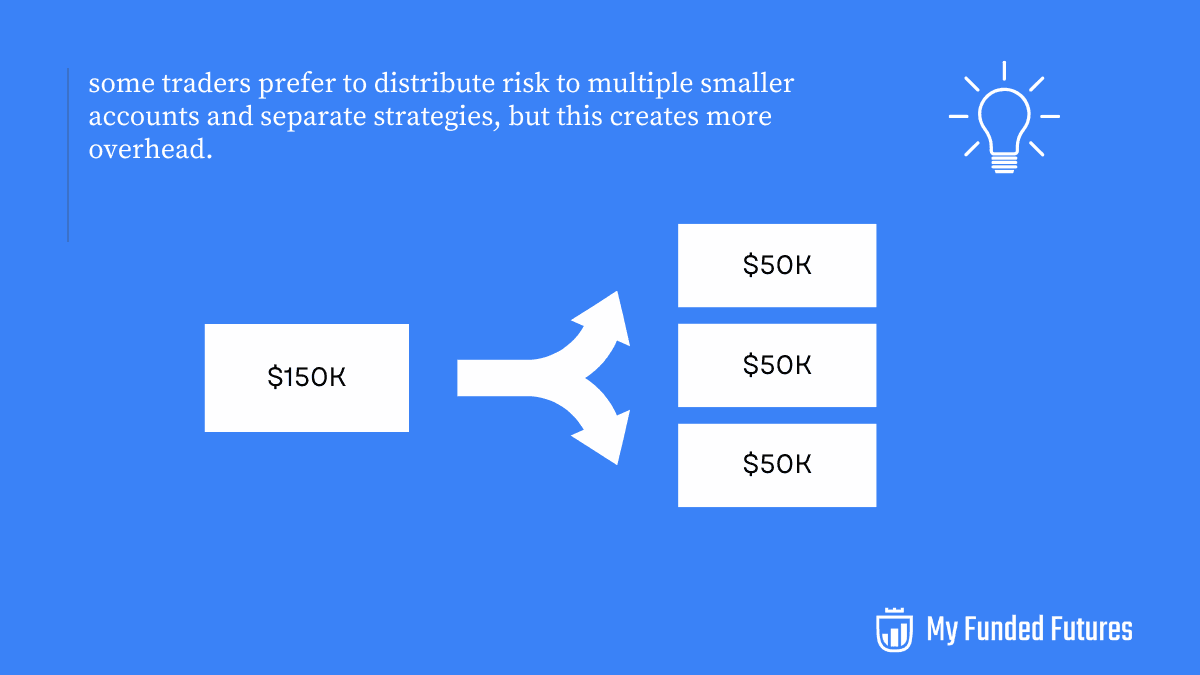
Multiple accounts distribute risk (a breach on one doesn't sink all), let you separate strategies, and can sidestep per-account payout caps. Trade-offs: more logins, potential duplicate data/connection fees, reliance on trade-copy tooling, and lower margin efficiency across separate buckets. One large account is simpler and uses capital more efficiently, but concentrates risk and can raise psychological stakes; one mistake can end the run. Match the structure to your workflow, tooling, and temperament.
| Factor | Multiple Small | One Large |
|---|---|---|
| Risk | Diversified | Concentrated |
| Ops | More setup; copier helps | Simple; single rulebook |
| Capital | Lower efficiency | Higher efficiency |
| Psychology | Lower per-account pressure | Bigger numbers, more stress (for some) |
| Best For | Strategy diversification, redundancy | Experienced traders needing size |
Common Mistakes to Avoid When Selecting Account Size
In the excitement of joining a prop program, traders often make these mistakes related to account choice.
-
Going Too Big, Too Soon: Don't jump into the largest account just because it's available or because you think bigger is always better. If you're new, start with a smaller challenge. You can always scale up later.
-
Not Budgeting for Multiple Attempts: Be honest with yourself; you might not pass on the first try. Plan your finances accordingly.
If you can afford $300, don't spend it all on one month of a $150K; you'd be better off doing three months of a $50K (3 x $100) assuming those are the actual prices and the plans have comparable rules and renewal terms. This gives you more practice and chances. Similarly, it's wise to decide ahead of time how many resets or months you're willing to attempt for a given account. This prevents the scenario of "just one more $100 reset..." turning into a money pit.
-
Overlooking the Rules Differences: Not all account sizes are identical in rules beyond just the numbers. Check if the drawdown is trailing vs end-of-day, if there's a consistency rule (some firms limit the percentage of total profits that can come from a single trading day), or if larger accounts require more "min days" of trading.
-
Chasing Discounts Blindly:Prop firms like MyFundedFutures frequently offer coupon codes to help kickstart traders' journey without having to worry excessively about finances. But getting such a discount shouldn't be the sole factor to decide your account size. For instance, if the $100K is 50% off but the $50K isn't, don't immediately jump to $100K unless you truly can handle it.
-
Ignoring Psychological Fit: Some traders just do better psychologically with one approach or the other. Perhaps you know that if the numbers get too big, you choke -- then stay smaller until you build tolerance.
-
Not Having a Plan for After Funding: This is a bit beyond account selection, but still relevant. Think ahead: once you pass, will you be comfortable trading that account under its funded-stage rules and payout conditions? Sometimes people pass a huge account by being very aggressive or even lucky but then they struggle in the funded phase where the psychology of real payouts and preserving capital kicks in. It might be better to grow into a large account than to start there undeservingly.
Ready to dive in?
Explore our challenge accounts, pick the one that fits you best, and start your journey to getting funded.
Explore AccountsTrading futures involves substantial risk of loss and is not suitable for all investors. You should carefully consider whether trading is appropriate in light of your financial condition, experience, and risk tolerance. Past performance is not indicative of future results.
Futures Disclaimer: Futures trading is highly leveraged and can result in losses greater than the funds deposited in your account. You may be required to deposit additional funds to maintain open positions, and rapid market moves can result in substantial losses.
Proprietary Trading Firm Disclaimer: Proprietary trading firms are not brokers and may operate under different regulatory frameworks. Funded accounts are internal evaluation arrangements, not customer brokerage accounts, and do not provide the same regulatory protections as registered broker-dealer or futures commission merchant accounts.
Income Disclaimer: Any payout or income examples provided are hypothetical and for illustrative purposes only. They do not guarantee future results. Actual outcomes vary and depend on trading performance, market conditions, and the specific rules of the prop firm program.
¹This material is provided for educational purposes only and should not be relied upon as trading, investment, tax, or legal advice. All participation in MyFundedFutures (MFFU) programs is conducted in a simulated environment only; no actual futures trading takes place. Performance in simulated accounts is not indicative of future results, and there is no guarantee of profits or success. Fewer than 1% of participants progress to a live-capital stage with an affiliated proprietary trading firm. Participation is at all times subject to the Simulated Trader Agreement and program rules.
Frequently Asked Questions
Related Posts
Read our most popular posts

Prop Firms With Static Drawdown in 2026: The Best Fixed-Risk Plans
Compare the best futures prop firms with static drawdown in 2026, including drawdown rules, account sizes, profit splits and payouts before you choose.

Fastest Prop Firm Payouts in 2026: Which Firms Pay Same Day?
Compare the fastest futures prop firm payouts in 2026, including eligibility rules, processing times, withdrawal limits, buffers and payout flexibility.

Announcing: MyFundedPerps
MyFunded announces MyFundedPerps, a new prop-trading platform expanding into perpetual futures and digital assets. Built on the foundation of MyFundedFutures with enhanced technology, it offers traders access to multiple markets and asset classes.
