
The rise of prop firms has meaningfully increased the number of retail traders entering the futures market. Instead of risking their own capital, traders can now pass an evaluation, prove consistency, and trade firm money. It sounds like a win-win. But as this space grows, so do the choices and the confusion.
Two models dominate: evaluation accounts and instant funding accounts. Evaluation accounts require you to pass a profit target under specific rules before you receive a funded account. Instant funding accounts, as the name suggests, skip the test and give you capital immediately, usually for a much higher fee.
On paper, instant funding looks tempting. No rules, no pressure, no need to pass a challenge. But under the surface, the math and structure tell a different story. Evaluation accounts almost always make more sense for serious futures traders, not because they are easier, but because they are fairer, cheaper, and far more sustainable.
What Prop Firms Actually Offer
Before comparing the two models, it helps to understand what prop firms are selling.
A prop firm offers a simulated or real-money trading account that lets you trade their capital and keep a portion of the profits. In return, you follow their rules: maximum drawdown, profit targets, daily limits, and consistency requirements. These rules protect the firm’s capital and weed out gamblers.
In most evaluation models, you pay a one-time or monthly fee to take a challenge. If you pass the profit target while staying within risk limits, you move to a funded stage. Once funded, you keep a profit share, often 80 to 90 percent, while the firm takes the rest as their cut for providing the capital.
Instant funding accounts skip the evaluation step. You pay a large upfront fee and start funded immediately. The trade-off is a much smaller profit split and tighter rules, even though you never had to prove consistency.
Sign up to get the latest articles in your inbox
Evaluation Accounts Explained
Evaluation accounts are structured around one idea: prove you can trade with discipline before touching firm money.
You typically pay between $50 and $200 for access, depending on account size. Evaluation fees vary by provider, account size, billing structure and promotions. Check whether the quoted price includes recurring fees, resets or activation charges. bncThe firm gives you a simulated account with a profit target, for example $3,000 on a $50,000 account, and specific drawdown limits. You must meet the goal without violating risk rules. If you succeed, you receive a funded account where you share profits with the firm.
The biggest advantage here is low cost and high potential reward. You can get started for the cost of a single losing day in your personal account. Once funded, most firms let you keep 80 to 90 percent of profits, far better than the splits offered by instant funding programs.
Even more important is the psychological filter. Passing an evaluation forces you to develop habits, patience, risk control, and the ability to follow a plan. These are the exact habits that keep traders alive once real money is on the line.
Instant Funding Accounts Explained
Instant funding is the opposite. Instead of proving consistency, you buy your way in. For a flat fee, sometimes hundreds or even thousands of dollars, you start trading a funded account immediately. There is no evaluation stage and no target to hit before profit sharing begins.
That might sound like freedom, but it is an expensive form of freedom. The upfront cost can be ten times higher than an evaluation account, and the profit splits are often worse, some as low as 50 or 60 percent. You also face tighter rules, lower trailing drawdowns, and more restrictions on withdrawals.
The appeal is emotional. Traders who are tired of failing evaluations see instant funding as a shortcut. But shortcuts in trading rarely work out. Most traders who choose instant funding burn out quickly because they enter without structure or accountability. The lack of an evaluation stage means no forced discipline, and without discipline, leverage and volatility quickly wipe them out.
The Cost Comparison
Let’s look at it in numbers.
Imagine two traders, both want to trade a $100,000 account.
Assume Trader A pays $150 for an evaluation with a $6,000 profit target and a $3,000 maximum drawdown. These figures are illustrative; actual requirements vary by provider and plan. Assume Trader B pays $1,000 for an instant funding plan with a $2,500 trailing drawdown. These are hypothetical figures, not universal industry terms.
Trader A's initial evaluation fee is $150, compared with Trader B's $1,000 instant funding fee. These amounts represent the initial fees, not necessarily the traders' total costs or maximum potential losses. Evaluation funding may cost less overall, but the result depends on the number of attempts, recurring fees, resets, activation charges and the likelihood of passing and qualifying for payouts.
At $150 per evaluation, five failed attempts would cost $750 before any additional charges. That is less than a $1,000 instant funding fee, but it does not establish which route offers better overall value. You could fail five evaluations and still spend less than the cost of one instant funding account, and when you finally pass, your profit share is significantly better.
Accountability and Skill Development
Passing an evaluation is not just about meeting a profit target. It proves that you can follow a set of rules under pressure. Instant funding replaces learning with pressure, and that combination usually ends badly. You learn to respect drawdowns, to pace yourself, and to stop trading when emotions take over.
Instant funding skips that step, which might sound like a relief at first, but it robs you of practice. You start trading funded before you have proven you can survive normal drawdowns. Some rookie traders treat it like a video game, not a business. Without an evaluation filter, it becomes easy to blow multiple instant accounts in a single month.
Evaluation programs also make your growth measurable. You can look at your stats, review your mistakes, and try again with minimal cost. That feedback loop is crucial.
Looking to Get Funded? Start here.
Profit Splits and Long-Term Value
Profit share is one of the most overlooked differences between these two models.
Evaluation-based funding firms typically pay 80 to 90 percent of profits to the trader. The logic is simple: you proved you can trade within rules, so the firm trusts you with a larger share.
Instant funding accounts often offer only 50 to 70 percent. The firm takes a bigger cut to offset their higher risk since they never tested you. In many cases, they also impose slower payout schedules, meaning you wait longer to withdraw profits.
If you plan to trade for months or years, this difference compounds. A trader making $5,000 per month at 90 percent keeps $4,500. At a 60% profit split, a trader receives $3,000 from $5,000 in eligible profits before any other applicable fees or deductions, compared with $4,500 at a 90% split. That gap adds up fast, and when you factor in the higher upfront fee, instant funding becomes even harder to justify.
Psychological Traps of Instant Funding
The biggest danger of instant funding is not the fee, it is the mindset it creates. You feel like you are trading real money, but in most cases you are still on a simulated platform. The illusion of freedom leads to impulsive decisions. You take bigger size, skip stops, or hold losers because you think you have a cushion.
There is also the sunk cost problem. After paying $1,000 or more for an instant account, many traders feel they must make it back. That pressure leads to emotional trading and bigger drawdowns. The firm still wins because you have to buy another account if you blow the first one.
Evaluation accounts flip this psychology. Because the entry cost is small, you can fail and retry without panic. The structure forces you to build consistency first, which is the only real path to longevity.
Also learn: How Do Prop Firm Payouts Work And How Can You Maximize Your Profit Share?
The Myth of Instant Freedom
Instant funding firms love to market freedom, no targets, no steps, no waiting. But freedom without structure rarely ends well.
In reality, you are not skipping the work. You are simply postponing it. If you cannot manage drawdown or follow rules in a simulated evaluation, you will not magically develop discipline in a live instant account. The difference is that now every mistake is more expensive.
Many traders who start with instant funding eventually move back to evaluations once they realize the economics and payout models make more sense. The slower path ends up being faster because it builds habits and keeps costs manageable.
When Instant Funding Might Make Sense
To be fair, instant funding is not completely useless. There are a few cases where it might fit.
If you already trade consistently, have passed evaluations in the past, and want to scale up temporarily for a market event, instant funding can be a short-term tool. It saves time if you know exactly what you are doing and accept the higher cost.
But that is a narrow slice of traders. For 95 percent of people entering the prop space, instant funding offers more risk than reward. Most would be better off taking one or two evaluation accounts, using them as training grounds, and earning their way up the funding ladder.
Evaluation Account | Instant Funding Account | |
|---|---|---|
Entry Fee | Low ($50–$200) | High ($500–$2,000+) |
Must Pass Challenge? | Yes | Generally not required |
Typical Profit Split | 80–90% | 50–70% |
Risk Rules | Fixed | Often Tighter |
Skill Development | Strong (forces discipline) | Weak (no structure) |
Long-Term Cost | Low | High |
Who It Fits | Learners, disciplined traders | Experienced pros scaling short-term |
Get started with an Evaluation Account
Why Evaluation Wins Long-Term
Evaluation models reward discipline, patience, and skill, the same traits professional traders rely on. Instant funding rewards impulsivity and the desire for shortcuts.
If you pass an evaluation, you have already demonstrated that you can manage risk and stay calm under pressure. That foundation makes it easier to scale, maintain consistency, and actually collect payouts. The lower cost, better profit split, and skill development combine to create a path that can last.
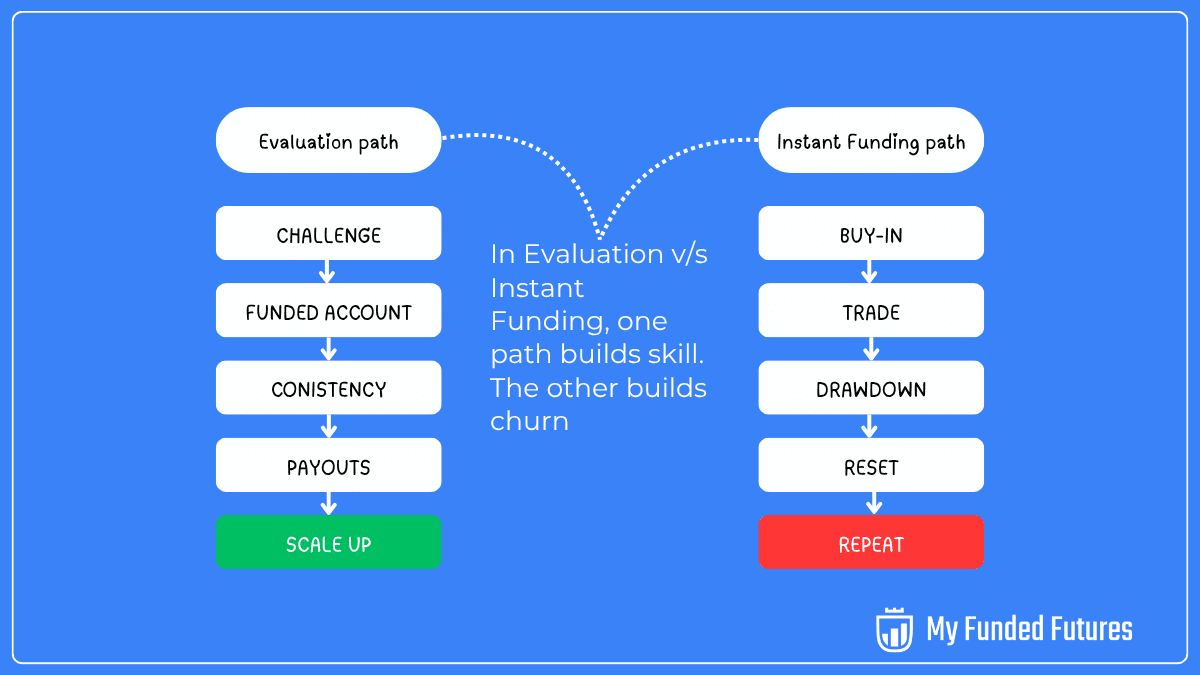
Instant funding, by contrast, is front-loaded. You pay heavily upfront, earn less, and often reset multiple times. It feels fast, but it rarely leads to stable income.
The traders who make it long-term are not the ones who look for shortcuts. They are the ones who respect the process, learn from each attempt, and treat every evaluation as part of their professional development.
Conclusion
Between evaluation and instant funding, the sensible choice for most futures traders is clear. Go with the evaluation model. It is cheaper to start, pays better in the long run, and forces you to develop real trading habits instead of relying on luck or emotion.
Instant funding might look convenient, but it often ends with frustration. The high cost, poor profit splits, and lack of structure turn what should be a learning opportunity into an expensive cycle. Evaluation accounts keep you grounded. They make you earn your capital and build discipline before you scale.
If your goal is steady progress rather than quick dopamine hits, evaluation funding will get you there. You will pay less, learn more, and have a far better chance of staying funded long enough to actually enjoy the rewards.
Ready to dive in?
Explore our challenge accounts, pick the one that fits you best, and start your journey to getting funded.
Explore AccountsDisclaimer: This material is provided for educational purposes only and should not be relied upon as trading, investment, tax, or legal advice. All participation in MyFundedFutures (MFFU) programs is conducted in a simulated environment only; no actual futures trading takes place. Performance in simulated accounts is not indicative of future results, and there is no guarantee of profits or success. Fewer than 1% of participants progress to a live-capital stage with an affiliated proprietary trading firm. Participation is at all times subject to the Simulated Trader Agreement and program rules.
¹This material is provided for educational purposes only and should not be relied upon as trading, investment, tax, or legal advice. All participation in MyFundedFutures (MFFU) programs is conducted in a simulated environment only; no actual futures trading takes place. Performance in simulated accounts is not indicative of future results, and there is no guarantee of profits or success. Fewer than 1% of participants progress to a live-capital stage with an affiliated proprietary trading firm. Participation is at all times subject to the Simulated Trader Agreement and program rules.
Related Posts
Read our most popular posts

Prop Firms With Static Drawdown in 2026: The Best Fixed-Risk Plans
Compare the best futures prop firms with static drawdown in 2026, including drawdown rules, account sizes, profit splits and payouts before you choose.

Fastest Prop Firm Payouts in 2026: Which Firms Pay Same Day?
Compare the fastest futures prop firm payouts in 2026, including eligibility rules, processing times, withdrawal limits, buffers and payout flexibility.

Announcing: MyFundedPerps
MyFunded announces MyFundedPerps, a new prop-trading platform expanding into perpetual futures and digital assets. Built on the foundation of MyFundedFutures with enhanced technology, it offers traders access to multiple markets and asset classes.
