
Choosing a prop trading firm involves more than comparing account sizes or promotional prices. Trading rules, drawdown limits, evaluation requirements, payout conditions, and the fees you pay can all affect your overall experience.
MyFundedFutures Studio and Vest Markets offer different approaches to funded trading. MyFundedFutures Studio focuses on futures trading with static drawdown limits and on-demand payout requests, while Vest Markets promotes a derivatives trading program with flexible profit claims and an 80% advertised profit share.
But which one offers the better deal?
In this comparison, we examine their rules, fees, payouts, advantages, and limitations to help you decide which program better matches your trading style. For an apples-to-apples comparison, MFFU’s Studio Plans are compared with Vest Markets’ Evaluation Account Plans rather than its Instant Plans.

| Feature | MyFundedFutures Studio | Vest Markets |
|---|---|---|
Instruments | CME Micro Futures Contract (stock indices/commodity and forex futures) | Perpetual futures across indices, equities, crypto, commodities, and forex. |
Entry pricing | $75, $140 or $280 for the listed Studio plans | $75/$150/$375/$745 tiers for evaluation accounts |
Evaluation | Profit target with a static maximum loss limit | Evaluation offerings, subject to applicable terms |
Drawdown | Static maximum loss limit during evaluation and simulated funding | $300-$3K depending on the account size. |
Daily Loss Limit | None | None |
Consistency Rule | None | None |
Profit share | 80% simulated-funded; 90% live | 80/20 for evaluation accounts |
Payout requests | Anytime on eligible simulated-funded accounts | On demand with live funded account |
*All data as of Nov. 5
What Is MyFundedFutures Studio?
MyFundedFutures Studio is a futures trading program from MyFundedFutures that introduces alternative account structures designed around simpler risk limits and more flexible payouts.
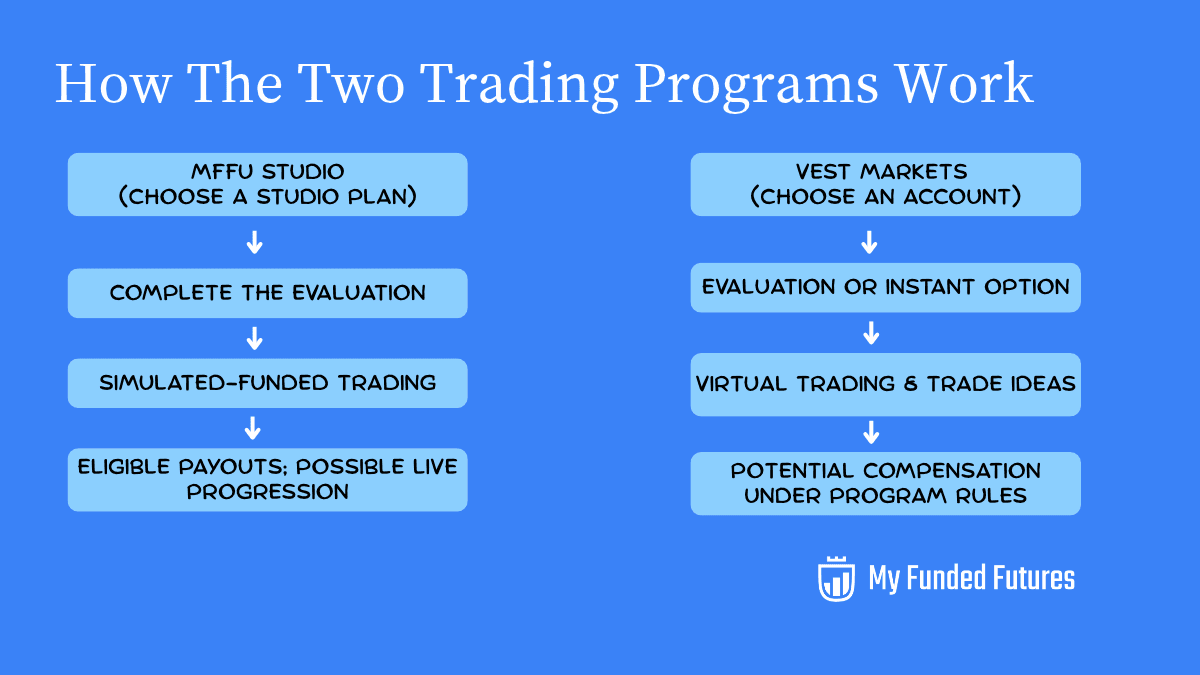
MyFundedFutures Studio uses simulated trading during evaluation and the Sim Funded stage, although eligible payout requests can result in real cash payments. A separate live account may become available after meeting the firm's progression requirements.
Its main attraction is the static Maximum Loss Limit (MLL). Unlike a trailing drawdown that can move upward as account equity increases, the Studio evaluation and simulated-funded stages use a fixed loss threshold.
The program also removes the daily loss limit and consistency rule found in some other prop trading plans.
MyFundedFutures Studio evaluates simulated trading performance using prices from CME markets, which are regulated by the CFTC. This does not mean MyFundedFutures itself is CFTC-regulated.
MyFundedFutures Studio plans and fees
| Plan | Account Size | Account Fees (one-time) | Profit Target | Maximum Loss | Daily profit cap (Sim-funded) |
|---|---|---|---|---|---|
Studio #003 | $5K | $75 | $500 | $250 | $2.5K |
Studio #001 | $10K | $140 | $1K | $500 | $5K |
Studio #002 | $20K | $280 | $2K | $1K | $10K |
All three plans have no activation fee. The listed plans also have no minimum evaluation trading days and no consistency rule.
The maximum contract sizes are five, 10, and 20 micro contracts, respectively, with no minis permitted in the evaluation and simulated-funded stages.
Key Studio trading rules
- Static drawdown: The maximum loss limit remains fixed during evaluation and simulated funding. This gives traders a clearly defined loss threshold.
- No daily loss limit: There is no separate daily loss limit on the listed Studio plans.
- No consistency requirement: Traders do not need to satisfy a consistency formula to pass the evaluation or request eligible simulated-funded payouts.
- No minimum trading days: Traders can reach the evaluation profit target without completing a prescribed number of trading days, provided they follow the remaining rules.
- **News trading: **The Studio rules permit news trading.
One restriction to remember is the seven-calendar-day inactivity rule. Traders should also monitor the plan-specific maximum contract size and daily profit cap.
What Is Vest Markets?
Vest Markets offers a proprietary trading program covering multiple asset classes, including cryptocurrencies, stocks, indices, commodities, and forex.
The platform promotes access to funded trading programs with an advertised 80% profit share. Its website also highlights on-demand profit claims and account options that may include instant access without a conventional evaluation.
However, the structure differs from a traditional brokerage account.
According to Vest Markets' terms available as of Nov. 5, participants provide trade ideas or signals through a program involving virtual accounts. Users do not execute trades and do not trade their own capital. All trading activity is conducted solely by Vest, its Affiliates, or designated third-party liquidity providers using their own capital and accounts.
Vest retains full discretion over whether, how, and if any user-generated input is used in live trading activity. It does not act as users’ agent, broker, or intermediary and does not execute transactions on their behalf.
This distinction matters when comparing Vest with a futures-focused program such as MyFundedFutures Studio.
Vest Markets fees and account
Vest Markets offers evaluation-based accounts with one-time fees that vary according to account size, profit target, daily loss limit and profit split.
| Plan | Account Size | Account Fees (one-time) |
|---|---|---|
Silver | $5K | $75 |
Gold | $10K | $150 |
Platinum | $25K | $375 |
Emerald | $50K | $745 |
Information available on Vest’s website as of Nov. 5 also states that participants can keep 80% of their earnings under its evaluation account plans. Terms of Service also state that any compensation a user may receive, if applicable, is determined solely in accordance with the Program rules and does not confer any ownership interest in trading activity.
Vest may receive revenue, rebates, or other financial incentives from third parties in connection with trading activity, such revenue is retained solely by the firm, and users have no claim, right, or entitlement to any such amounts.
Another important consideration is its refund policy. Its terms generally allow a refund request within three days of purchase only if the participant has not started using the program or account. Once participation begins, fees are generally non-refundable.
Trading Rules: Which Program Is More Flexible?
Trading rules can determine whether a profitable strategy remains eligible for a payout. This makes the loss limit, consistency requirements, and contract restrictions especially important.
Drawdown rules
MyFundedFutures Studio uses a static maximum loss limit during evaluation and simulated funding. For example, Studio #001 has a $500 limit, while Studio #002 has a $1,000 limit.
This structure makes the loss threshold predictable, provided traders understand how the limit is applied.
Vest Markets uses the loss limits associated with its specific program. Maximum drawdown range from $300 to $3K, depending on the account type. Its rules should be reviewed carefully before comparing the amount of risk permitted with a Studio account.
Daily loss limits
Studio's rules specify no daily loss limit. Traders must still respect the overall maximum loss limit.
Vest's restrictions depend on the account offering. The firm advertises a program with a single maximum drawdown rule and an optional daily loss limit for bespoke accounts, but traders should verify the exact conditions applicable to their purchase.
Traders looking for additional market sentiment insights can use MarketFramework's Are Profitable Traders Long? tool to track whether consistently profitable traders are leaning long or short.
Consistency rules
Studio does not impose a consistency rule during evaluation or simulated funding on its listed plans.
Vest Markets also advertises no consistency rule for its unrestricted trading offering.
For traders whose profits vary significantly from one day to another, this may make either offering attractive. Nevertheless, the absence of a consistency rule does not eliminate other risk limits or guarantee compensation.
Trading instruments and account control
This is one of the biggest differences between the programs.
MyFundedFutures Studio is designed for futures trading, with contract limits expressed in micro contracts.
Vest Markets offers a broader derivatives program and uses a virtual-account and trade-idea model. Participants do not independently execute trades through a live brokerage account
Fees: Which Program Offers Better Value?
The headline purchase price is only one part of the comparison.
MyFundedFutures Studio charges a one-time fee of $75, $140, or $280 for its published #003, #001, and #002 plans, respectively. There is no additional activation fee.
Vest Markets advertises entry prices beginning at $75, with higher-priced options available.
The entry price is the same but the account structures, trading instruments, risk limits, and payout arrangements differ.
A fair comparison should consider:
- The initial purchase price.
- Any activation or additional charges.
- The number of attempts or purchases you may need.
- The permitted trading instruments and risk limits.
- The payout eligibility requirements.
- The consequences of breaching the account rules.
Verdict on fees: Vest Capital's evaluation accounts start at $75 for the $5,000 Silver plan, with prices increasing to $150 for Gold ($10,000), $375 for Platinum ($25,000), and $745 for Emerald ($50,000). Each plan requires a one-time payment and includes a 10% evaluation target, an 80% profit split, and no daily loss limit.
Compared with MyFundedFutures Studio, which starts at $75 for its $5,000 account, Vest Capital has the same entry price. However, the two programs differ in their account structures, drawdown rules, and evaluation requirements, so traders should compare the complete account conditions rather than fees alone.
Payout Rules: How Do They Compare?
Payout rules often matter more than the advertised profit split. A high percentage is less useful if a trader cannot satisfy the withdrawal conditions.

MyFundedFutures Studio payouts
During the simulated-funded stage, Studio offers payout requests at any time once positions are closed and the account meets the applicable conditions.
For Studio #001 and #002, the minimum payout request is $250 before the profit split. Studio #003 has a $100 minimum.
The simulated-funded profit split is 80% to the trader and 20% to the firm.
For example, if a qualifying Studio #001 trader requests $1,000 in gross profits, the trader's share would be $800 before any other applicable deductions.
The firm states that Studio does not require a waiting period, payout buffer, or qualifying trading days for these simulated-funded requests.
Traders become eligible for consideration for a live account after five approved payouts or $5,000 in total requested payouts. The live account starts with 40% of the total amount requested, capped at $2,000, and uses an end-of-day trailing Maximum Loss Limit rather than the static drawdown applied during evaluation and simulated funding. Live accounts offer a 90/10 profit split, a $250 minimum payout, and one payout request per day.
Vest Markets payouts
Vest Markets offers an 80% profit split on its Capital Evaluation Accounts. Participants may receive compensation based on eligible trading results, subject to the applicable program rules and payout conditions.
For illustration, an eligible $1,000 compensation amount under an 80% profit split would leave $800 for the participant. However, this calculation does not mean that $1,000 in virtual trading profits automatically qualifies for payment.
Verdict on Payouts: Both Vest Capital and MyFundedFutures Studio advertise an 80% profit split. However, MyFundedFutures Studio provides more explicit payout conditions, including minimum withdrawal amounts and a defined progression to live trading. Vest Capital's compensation structure requires closer attention to its program-specific terms, particularly regarding eligibility and profit claims.
Pros and Cons
MyFundedFutures Studio
Pros
- Static drawdown during evaluation and simulated funding.
- No daily loss limit or consistency rule on the listed plans.
- No activation fee.
- Defined payout minimums and profit splits.
- A futures-specific trading structure.
Cons
- Limited availability and purchase caps may affect access.
- Contract limits restrict position sizing.
- Daily profit caps apply during simulated funding.
- Live-account rules differ from simulated-funded rules.
- One active Studio account is permitted at a time.
Vest Markets
Pros
- Offers multiple evaluation account sizes, from $5,000 to $50,000.
- Supports multiple asset classes.
- Advertises an 80% profit split across its evaluation accounts.
- Offers a one-time evaluation fee rather than a recurring monthly subscription.
- Evaluation plans shown do not impose a daily loss limit.
Cons
- Participants do not directly control live brokerage accounts.
- Displayed account balances are virtual.
- Compensation depends on program terms and eligibility.
- Fees generally become non-refundable once participation begins.
- Account-specific loss limits and other restrictions require careful review.
Which Should You Choose?
The better option depends on your priorities.
Choose MyFundedFutures Studio if you specifically want a futures-focused program, prefer a static loss limit, and value published evaluation rules and defined payout minimums.
Consider Vest Markets if you prefer a broader derivatives offering, want to explore its advertised instant-access options, and understand the distinction between virtual trading results and compensation under its program.
Neither program should be selected solely because of its advertised account size, low entry price, or profit split. Your decision should reflect the applicable loss limits, purchase costs, trading restrictions, and conditions for receiving compensation.
Final Verdict
MyFundedFutures Studio and Vest Markets appeal to different types of traders.
MyFundedFutures Studio stands out for its static drawdown, absence of a consistency rule, and clearly published futures-specific payout structure. Vest Markets emphasizes low advertised entry prices, multiple asset classes, and flexible profit claims.
The deciding factor is not simply which firm offers the larger account or the lowest fee. It is which program's rules, risk limits, and compensation terms fit your trading strategy.
Before purchasing either program, read the current official terms for your exact plan, confirm all fees and payout conditions, and understand what the displayed account balance represents.
¹This material is provided for educational purposes only and should not be relied upon as trading, investment, tax, or legal advice. All participation in MyFundedFutures (MFFU) programs is conducted in a simulated environment only; no actual futures trading takes place. Performance in simulated accounts is not indicative of future results, and there is no guarantee of profits or success. Fewer than 1% of participants progress to a live-capital stage with an affiliated proprietary trading firm. Participation is at all times subject to the Simulated Trader Agreement and program rules.
Frequently Asked Questions
Related Posts
Read our most popular posts

Tokenized Stock Perps Explained: Trading Tesla, Apple and Nvidia 24/7
Learn how tokenized stock perpetuals work, how to trade Tesla, Apple and Nvidia price movements, and what to know about leverage, funding fees and risk.

Perpetual Futures vs Futures: What's the Difference?
Learn the difference between perpetual futures and traditional futures, including expiration, funding rates, rollover costs, margin, settlement and trading risks.

Announcing: MyFundedPerps
MyFunded announces MyFundedPerps, a new prop-trading platform expanding into perpetual futures and digital assets. Built on the foundation of MyFundedFutures with enhanced technology, it offers traders access to multiple markets and asset classes.